Sunday, March 18, 2012

Reflections on Jean Paul Sartre & Existentialism

Well, since the book we are reading in our book club these days is The Words by Sartre, I thought to pen down his views on existentialism.
Sartre's Existentialism can be seen as a rigorous attempt to work out the implications of man's individualism.He asks:

What is human freedom? What can the absolute freedom of absolute individuals mean?

What is human flourishing or human happiness? What general ethic or way of life emerges when we take our individuality seriously?

What ought we to do? What ethics or code of action can emerge from a position that takes our individuality seriously.


When you think of it, each of us is alone in the world. Only we feel our pains, our pleasures, our hopes, and our fears immediately, subjectively, from the inside. Other people only see us from the outside, objectively, and, hard as we may try, we can only see them from the outside. No one else can feel what we feel, and we cannot feel what is going on in any one else's mind. Actually, when you think of it, the only thing we ever perceive immediately and directly is ourselves and the images and experiences in our mind. When we look at another person or object, we don't see it directly as it is; we see it only as it is represented in our own experience.hen you look at the person next to you do you really see them as they are on the inside or feel what they feel? You see only the image of them that is presented to your mind through your senses. This is easily demonstrated by considering how our senses deceive us in optical illusions, but one simple example will have to suffice here.

It seems, then, that we are minds trapped in bodies, only perceiving the images transmitted to us through our bodies and their senses. Each of us is trapped within our own mind, unable to feel anything but our own feelings and experiences. It is as if each of us is trapped in a dark room with no windows.

The Existentialist View--Sartre says that what all existentialists share in common "... is that they think that existence precedes essence, or, if you prefer, that subjectivity must be the starting point." Sartre explains what this means by contrasting it with the opposite slogan: ESSENCE PRECEDES EXISTENCE

He says "Let us consider some object that is manufactured, for example, a book or a paper-cutter: here is an object which has been made by an artisan whose inspiration came from a concept. He referred to the concept of what a paper-cutter is ... . Thus, the paper-cutter is at once an object produced in a certain way and, on the other hand, one having a specific use ... . Therefore, let us say that, for the paper-cutter, essence ... precedes existence."

Of course, the artisan in our case is God. Sartre continues: "When we conceive of God as the Creator, He is generally thought of as a superior sort of artisan. ... Thus the concept of man in the mind of God is comparable to the concept of the paper-cutter in the mind of the manufacturer... . Thus, the individual man is the realization of a certain concept in the divine intelligence."

On this view, the one Sartre is attacking, we get our nature from outside of us, from a being who created us with a preconceived idea of what we were to be and what we were to be good for. Our happiness and our fulfillment consist in our living up to the external standards that God had in mind in creating us. Both our nature and our value come from outside of us.

According to the existentialist, however, EXISTENCE PRECEDES ESSENCE. Sartre explains:

"What is meant here by saying that existence precedes essence? It means that first of all, man exists, turns up, appears on the scene, and, only afterwards, defines himself. ... Not only is man what he conceives himself to be, but he is also only what he wills himself to be after this thrust toward existence.
Man is nothing else but what he makes of himself"

Thus, there is no human nature which provides us with an external source of determination and value.

Sartre says:"If existence really does precede essence, there is no explaining things away by reference to a fixed and given human nature. In other words, there is no determinism, man is free, man is freedom."

Among the things we find on the mental tv screen, besides objects, other people, emotions, and desires, is ourselves. I see my body, and this thing I see is me. The human condition, for the Existentialist is a tension, a vertiginous imbalance, between the self that watches these images, standing apart from them, and the self that appears as an image. Just as I feel an imbalance upon walking into a department store and finding that one of the people on the video monitor is ME (caught by some unseen camera); or just as we feel a tension looking in the mirror wondering how the person in the glass can be ME if I am standing out here looking at it; so the self feels a tension between identifying itself with mind's eye behind the screen (standing apart from the give and take, the flux and flow, of our experience) and the images of us that appear as part of our experience (engaged in the world)

Thus, we all have the tendency to act in bad faith, to identify ourselves with one of the pictures we find on our mental TV screen, and to see ourselves as determined by one of the outside influences we find pictured there: our nature, our body, the physical world, or the expectations and pictures other people have of us. We are all familiar with the ways in which we try to excuse our actions by pretending that we are simply our bodies and are controlled by the forces that determine them. We have all said things like:


I can't talk to people, I just don't have that kind of personality.

I can't pass this course, I'm just don't have the brain for calculus.

I can't help the fact that I was born a man (or a woman); Certain things come naturally for certain types of people. (Says the man who can't take care of his children, or the woman who can't drive her car.)

I'm no good at this; I guess I just wasn't made to go to college.

I'm sorry I bit your head off yesterday. I must be premenstrual.

I don't know what happened. I guess the beer made me crazy.

In these cases, I am identifying myself with one of the pictures of me I find on my mental TV screen: I am my body, or my brain, or my personality, or my hormones. In each of these cases, I am deceiving myself. I am more than just these, and no matter how I try to avoid it, I am free.

I am not identical with any of the externally determined images on my mental TV screen. I am forever beyond the reach of their determinations within the island of my subjectivity.Even if I were a puppet, my body and its actions completely controlled by some malevolent master, what I am, my mind's eye would still be free and untouched. I could still be free to rebel against my master or make whatever I wished of the situation. They can do what they want to my body, manipulate the objects or pictures of me on my mental TV screen, but they can never touch or control the real me. The self within its island of subjectivity is radically free in virtue of its radical individuality.

Furthermore, I have control over the content of my TV screen as well. External circumstances may determine the objects that appear, how they appear, and when they appear, but I control how these various components will be put together into a coherent picture. Sartre compares the type of freedom we have to that of an artist. An artist cannot control the nature of the canvas, nor of the paints that she has to work with. Nor can she control the nature of the subjects she will paint. But she can control how she will view them, how she will put these various elements together into a unique whole. Likewise, we may not be able to control the various elements within our experience that come from outside us, but we can view them and combine them in any way we like. Our experience is not any one of these; it is the way in which we combine these into a unified whole. We have the power to edit the frames which constitute our experience into the film that is to be our life.

Summing up:

1) Our absolute individuality isolates our real self from the determining influences of the outside world; we can always rebel against its influence; and

(2) Even though the raw material that makes up our experience is determined by outside influences we are free to put these elements together into a unified whole; we must make ourselves anew at each moment, and what we shall make of ourselves is up to us.

Saturday, March 10, 2012

Reflections on J.Krishnamurti

LIFE...LIVE...The ‘f’ in life renders it so many dimensions-failures, fears, fame, forlorn and on and on. LIVE is so uncomplicated, so within the moment, mindless, fleeting and atomic. The other day I was wondering, human mind is very well exemplified by a squirrel-restless, impatient and wandering.

As a species, we are a crisis in motion, aware of our diminutiveness to the whole and yet suffering from the syndrome to strive for identity. Why is anonymity such a sin? Why can’t I be nobody? Not identify with anything but emptiness and consequently not identify emptiness with negation and finiteness but with beauty and infiniteness.

It is always engrossing to hear J. Krishnamurti and read his commentaries and writings on living(not life!). His answer to the question ‘who are you or who am I’ was enquiring and penetrating. Are we the ‘story of mankind’? Product of imitations? If our education is not largely a pursuit of imitations of various kinds, then how is it that the self is so attached to the want of an identity? The self finds it impossible to be free from the clutches of identity....it cannot be anonymous. All our inner and outer activities become gratification of our self, to be made exclusive, to be recognised. The famous, the popular is pursued and the anonymity is deprecated. We strive.

Everyday is lived with a purpose, a goal. An achievement made and another to make. It gives gratification to self, a meaning to life. If one day you wake up and are told that life is meaningless, you will get depressed. But why? When only the finite has the meaning. A rose is totally meaningless. It is just there for no reason at all.....beautiful, infinite, mysterious.

The self makes all the effort to move away from what it is. Through renunciation or acquisition, either way it continues moving away from what it actually is. Apart from the name, the position, the profession, the attributes, the idiosyncrasies what is ‘the self’? Is there the ‘I’ when the very qualities are snatched away? Or is it the very fear of being totally poor that drives the self into constant activity; for it is nothing but emptiness. The emptiness that is beautiful like the rose and whose embrace brings about the transformation within. It is the experiencing of what is without naming it to get freedom from what is.


Tuesday, January 31, 2012

Structure & the Tree

Somehow, I have always found this gift of wry smile very dear to me. Dear Uncle Dick was quintessentially for this blog to wake up from its slumber, wearing a grey suit last worn in 1960s. And, when I start smiling while standing across him in the Delhi metro, he looks at me with an eye that has sympathy (the one for a crackpot weirdo). Behold Delhi Metro! Uncle Dick feels the sudden surge to strangle me with his words of wisdom. Seeing the awkwardness, I point him to the poster behind......”Manipal university- Now in Jaipur”..........nearby all the eccentrics, visionaries, a man reading obituary, another having a blackberry; all look up. One of them from that elite club sheds his inhibitions and asks “so?”.....and I say that “nothing, I was just reminded of a similar poster that read BIG BAZAAR-Now in Bangalore”

Ladies and Gentlemen, facebook-err(s) and suckers, today I plan to get adrift from the world of cronies and ponies, the world made of gravitas, pietas, dignitas and virtus.......”all the children are insane, waiting for the summer rain.....”so rambles Jim Morrison and intermittently interrupted by the buzz of cell phone orchestrated by another of those nagging, dragging, sagging wags....I wonder! So has been the evolutionary outcome that we mask the savage with structure....The manifestation of structure contradicts the very essence of existentiality but still exists as a manifestation all the time.....a projection or a paradox? Or perhaps both?

Listen to Bach.....it flows.....flows and stays....See a Michelangelo....it stays and stays....the quintessential beauty in its two forms or rather one with a form and other with none.But beauty like that belongs to everyone so love like beauty should too and then do I intend to proclaim “everyone belongs to everyone else” courtesy Aldous Huxley, Brave New World? Hell, No! But rather like a point source of light (for my love for optics!!) it should radiate in all directions........like my Boss!! Who does the complete antagonistic process to be hailed as “the Black Body” radiation...

For, in fact, what is man in nature? A Nothing in comparison with the Infinite, an All in comparison with the Nothing, a mean between nothing and everything. Since he is infinitely removed from comprehending the extremes, the end of things and their beginning are hopelessly hidden from him in an impenetrable secret; he is equally incapable of seeing the Nothing from which he was made, and the Infinite in which he is swallowed up.

I saw ‘The Tree Of Life’ last night. Just like Sean Penn, who spends the day in the office remembering about his brothers and family, the most urgent thing I feel I have to do this morning is to write about the movie. I haven't be so much impressed by a story, a song or a a film from a very long time.

It should go without saying, but let me tell you that this is not a film you should see if you just want to stop thinking about your life for a couple of hours. This should be kind of automatic, i know: but it's worth mentioning, as it would be really a pity to see flourishing such comments or opinions like "i was expecting something else" or "it's very slow paced" or "i didn't really understand that part of the story". Go watch this movie if you want (or: if you NEED) to think about yourself and your life and your story and your future MORE than you usually do, not less. Go watch this movie if you want to find a companion voice wondering together with you about what kind of relationship can be found between our personal stories and the story of the universe, between the quickness of a lizard running across a summer cornfield in Texas and the infinite spaces dividing the countless stars of the universe, between the tenderness of the love that you felt for your parents as a child and the plain fact that in order to grow up, to reproduce that love, you had to leave that child and that love behind you. The voice will help you to realize that the missing links are actually there, in front of your eyes; that in order to see them, your eyes must be open; and that regaining the innocence that seemed lost forever is the key, and the result, of understanding and accepting the presence of those links, opening your eyes.

Thursday, May 19, 2011

THE ILLUSION

The illusion of remembering is both gratifying and devastating; moreover, so much is its pervasiveness that the existence of an extended insomnia is deceived with an illusion of life. And we wake up from the sleep to realize that the eternal sleep is not the illusion, rather its very cognizance is the precursor to the discovery of existentialism for every soul. But, the preponderance of illusion over realism, though seemingly a hyperbole on the outset, is the stimulation of our being and the quintessence of that ever criticized delusional divinity. Then, why we suffer from that need to be awakened from the illusion? The biological, that arrogant scientific answer is too polemical and becomes prostrate with impudence too soon; an illusion it casts in itself. May be we shall never arrive at a conclusion but the ramifications of the illusion throws our brevity and fragility on our face and shows how beguiling this greatest paradox probably is…..The illusion of the earthly virtues and the ever ephemeral rationale, the illusion of enigmatic belief…..the illusion that leads to the most mystic illusion – “the illusion of I”

Thursday, March 3, 2011

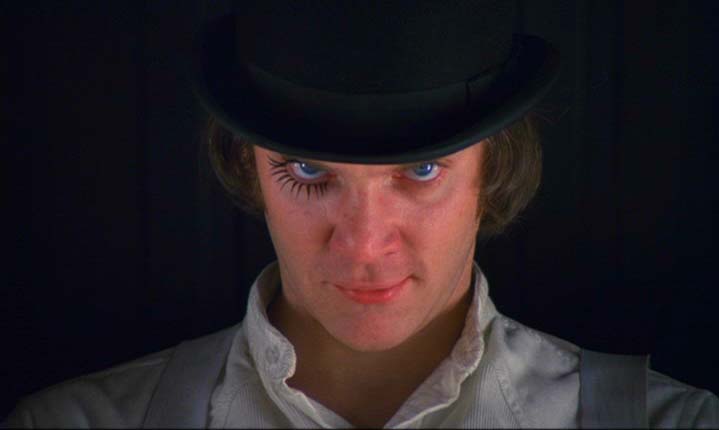
Viddy well little brother, Viddy Well!


For those that view cinematic entertainment as popcorn with CGI sequences of continual action then this will annoy and likely disappoint you, and for those that will not look past this film's exterior, I am sorry you missed out, but this is cinematic entertainment at its purest, thoughtful and thought-out theatre which will play with your mind, and you may not even know it.As many know, A Clockwork Orange at its heart is the story of state control versus free will, but at such extreme ends of the spectrum that it can off-put some.Stanley Kubrick takes an allegedly unfilmable novel by Anthony Burgess and transforms it into one of the great masterpieces of cinema. What, exactly, is A Clockwork Orange? A sci-fi social study? A fiercely thought-provoking and disturbing black comedy? A prescient warning of where society is headed? A criticism of how the law deals with crime and criminals? The list could go on and on, for the film could indeed be described as many things. But whichever way one chooses to approach the film, one thing is certain: it is without doubt one of the most uncompromisingly challenging examinations of the many faces of violence ever made. Where lies the attraction of violence, what are the consequences of violence, is there a solution to violence? It would be easy to expect a glib and sentimental answer to such questions, perhaps some comfortable conclusion that even the most evil of individuals is good at heart. But A Clockwork Orange avoids sentimentality and glibness and comfortable conclusions. This is a chilling film which points out that a solution to one evil is very often the evolution of another.Clockwork Orange places characters into categorical extrema. There are the ultra-conservatives who refuse to believe in a problematic society (Alex's parents). There are the women and men who become victims of brutality (rape and beaten victims). And finally exists the stereotypical sexually aggressive, libido-driven males who wreak havoc on society (the gangs). These stereotypical extrema exaggerate society in a way which critiques the behavior of individuals. Deriving from these specifics is a theme of predator-prey between males and females. Females appear only in powerless situations, which they have no control and no resolve. Women become a backdrop to the film, casting their importance away in society.

There were a spate of dystopian science-fiction movies made in the early seventies - Soylent Green, THX 1138, Rollerball, Logan's Run, etc - all of which vaguely look and feel like each other, but none of them are anything like Kubrick's future shock classic. Instead of spending a fortune on flashy spotless techno-sets, it was shot in incredibly ugly (even by sixties standards) concrete housing estates in Thamesmead and Wandsworth in south London and concentrates on its characters and social setups. Its genius is not to focus on what the future looks like, but what life would be like, and its prophecy of a bland, uncaring society and a government obsessed with popularity, social engineering and restricting personal freedom is absolutely bang-on (if you don't believe me, think about how much our leaders now spend on polls and thinktanks and how much legislation they pass simply because they don't trust us). Morally, it also has a completely original structure - it gives us a loathsome, horrible protagonist, shows him at his very worst, and then asks us to identify and sympathise with him as he is pulped through a cruel political machinery seeking only to exploit him. Through your reaction to this, Kubrick is really defining your own character, an incredible thing for a movie to do. If you think Alex really is an irredeemable thug (as so many self-appointed moral guardians did when the movie was released) then you know very little of human nature and how environment influences us. But if you sympathise with him (as I do), what does that say about you ? Through Alex, the movie examines the odd connection and conflict between morality and intelligence / identity / creativity, and does so on multiple levels - personal, social, religious, even biological. Kubrick's chief desire in his movies was to get the audience to think and ask questions, and the ultimate question here is when Alex is cured at the end, is that good or bad ? My answer is that it's both good and bad, but it's undeniably sensational and mindbending. The lynchpin of these questions, and the film in general, is the career-best performance by the sublime McDowell as Alex.He simply is Alex; he's physically amazing, he grasps the tone (especially the humorous aspects) of the character completely, he understands the movie's purpose and he plays each scene with incredible power, his cunning blue eyes and gleeful smirk burning up the screen. This is not straight drama or method acting, it's an extremely stylised performance to suit the movie, but it's just sensational in every way. The moment in the penultimate shot, when McDowell grimaces and stares insanely upwards, his bestial machismo restored, is the ultimate Kubrick Look, which recurs in many of his films, but never better personified than here. The rest of the cast are a terrific bunch of weirdos, notably Clarke, Morris and Stone, and Sharp gives his oily politician just the right mixture of snobbish disdain and patronising double-talk.

In the UK the film was stigmatised as glorifying violence (Straw Dogs and The Exorcist suffered similar fates) and a hate campaign against Kubrick resulted in his pulling it; outside of bootlegs it was impossible to see here until after his death in 1999. This is both extraordinary - that a director would have the power to pull his own movie out of circulation - and detestable - that philistine idiots who object to artistic freedom would resort to the type of violence they pretend to be protecting everybody else from. The movie remains a work of total genius, and its stunning originality and extraordinary imagery are to be savoured.The Background score is incredible (Beethoven anyone?), Malcolm McDowell is unbelievable and given his performance you can see why Kubrick said he wouldn't go ahead with the film if he couldn't get his signature. Visually the film is fantastic, and the vernacular used (called NASDAT I believe) is enthralling.

Kubrick was never a director afraid to take a risk, this was his follow up to 2001: a space odyssey (1968), it cost a mere $2 million dollars, how many directors can claim to make a risk like that, very few that I can think of. Which makes it all the more surprising whilst watching A Clockwork orange, with the fact that Kubrick was a man of his forties when he made the film, yet he has such an understanding of his young characters, he puts us with the evil droogs and still manages to make us care something for them. This was of course the problem with the film. Kubrick making us feel empathy for these amoral characters made the film one of the most controversial ever made (in Britain mainly) it seamed to be a culmination of all the problems that seemed to be around at the time - of course, as we all know now - Kubrick withdrew it.The first half is a joyously fast forty minutes, cut to a frantic, almost non-stop music score. The second half, much slower, much more silent, as if Kubrick is showing us what kind of pain Alex is going through, even if his character hides it under charm and constant exuberance.

Oddly enough in these modern days, the scariest thing about A Clockwork Orange is nothing that stems from the screen, but the growing notion that we are closer to the reality of Alex with every day...

Sunday, October 31, 2010

lolita: a murder of morals or is it?


It took me a lot of time to convince myself that Lolita was not a love story but a tale of self-deception and rationalization masquerading as "love". Its a conundrum,an illusion that requires a lot of insight into Humbert Humbert and still one might be on the edge.The character's construction is a marvel in itself,you will repel and sympathise at the same time while forgetting his lecherous desires.The narrator, Humbert Humbert, is a fascinating construction. As readers, we find ourselves simultaneously repelled by his actions and sympathetic to his yearning. We are utterly charmed by his wit, intelligence and verbal acrobatics, sometimes to the point where we lost sight of what he's doing to his object of desire, Lolita.
I would suggest that all readers reaquaint themselves with the concept of the "unreliable narrator" before they sink into Humbert's hypnotic web of logic. When you find yourself sympathizing with Hum about Lolita's "cruelties", try to remember that you are seeing everything through his twisted and self-serving lens. Humbert has rationalized his behavior so deeply and reports it to us so entertainingly, that we find ourselves accepting his interpretations of people and events at face value. However, we must remember that Hum is capable of the most monsterous of deceptions (note how long it takes him to inform Lolita of her mother's demise), and of self deceptions. Read between the lines. Question his reading of events. Pay attention when his reporting is at odds with his interpretations of them. As one example, Humbert tells us that he was seduced by Lolita, giving us the impression that she was sexually mature and a willing partner. Contrast that with his throwaway mentioning of her "performing" for him in exchange for treats, and watching television as he took his pleasure in her. And don't ignore Lolita sobbing each night, as he seems to do.
Look beyond the circus to the grime beneath it, and appreciate the mastery that gives us both.


I would therefore like to restrict my comments to the morality of the book, and to those who to this day view the book with outrage. Even those who admire the book somehow feel compelled to comment that they are "disturbed" by it. Why is this? Let us first examine the novel itself.
As everybody knows, it is the story of Humbert Humbert, a full-grown, adult male--not an old man--who seduces a compliant twelve-year old girl, and then goes on to have a year or so long "affair" with her. I put the term "affair" in quotation marks, because it probably isn't appropriate to describe a sexual relationship between a full grown male and a female child in such terms. Is it safe to say that most rational human beings disapprove of such relationships? It is certainly safe to say that Nabakov--and his narrator--know that such relationships are wrong. This is important. The tale is not only told in the context of a moral universe, it is also told by a character who is in acceptance of a moral universe. Oh, he makes a comment here and there about some medieval king marrying his twelve year old cousin, but clearly, his heart isn't in it. He knows that he is a monster, a "brute."
Indeed, his goal was never to have sex with a conscious Lolita to begin with. His goal initially was only to fondle her after drugging her to induce sleep; she was never to know what he was doing. Of course this is also reprehensible, but clearly it shows a conscience at work. A conscience motivated in part by fear, to be sure, but also a conscience for the welfare--at least early on--of this little girl. Conscience is not normally a factor in purely prurient forms of entertainment.
Following this encounter, he takes Lolita on a journey across, around, and through the United States, living in hotel rooms, and buying clothes and food on the move. Toward the end of this, we find one of the most moving paragraphs in literature: "And so we rolled East . . . We had been everywhere. We had really seen nothing. And I catch myself thinking today that our long journey had only defiled with a sinuous trail of slime the lovely, trustful, dreamy, enormous country that by then, in retrospect, was no more to us than a collection of dog-eared maps, ruined tour-books, old tires, and her sobs in the night--every night, every night--the moment I feigned sleep." The narrator's revelation of such anguish on the part of his victim clearly works against the argument that this novel was merely intended to be pornographic.
Humbert makes it clear that he loves his Lolita. There can be no mistake about this. He loves the way she moves. He loves the down on her arm. He loves her grace on the tennis court. He loves the way she flicks her head at him when looking up from a book. He loves her toes, her shoes, her name. He describes her in beautiful, poignant, poetic language, memorable and moving in every respect. Indeed the English language has rarely been used so wonderfully. But nowhere in this book does he describe in such terms or any other terms her sexual characteristics, or comment at length or in glaring detail his physical relations with her.
Finally, there is no effort to sugar-coat the effect of all of this on Lolita herself. We learn that after she left Humbert, she entered into a series of tawdry sexual escapades--still at too young an age--with a debased playwright. We last see her in her late teens, married to a bumpkin, and living in a clapboard shack surrounded by weeds.
Obviously, to anybody who has bothered to read this book, the presentation of the subject matter is not what is objectionable. Therefore, what apparently disturbs most people is the subject matter itself. But why? Why doesn't the latest grisly serial-killer-of-the-month novel inspire such protest? (Has there ever been a time in the history of the world in which so many novels have been written about serial killers?) Why not the barely-disguised soft-porn trash by Danielle Steele or Jackie Collins? Or the latest Anne Rice gore fest? While Lolita is not really a morality tale, it certainly doesn't glorify its subject matter the way novels such as these do.
So what is it? I think that with Lolita Nabakov has perhaps unconsciously touched a nerve. We, as humans, are rational creatures. We know what is right, and we have set rules for ourselves to follow. Everybody agrees that murder is wrong. But sexual mores have changed and continue to change in our affluent Western societies. Abortion has become legal, which gives women more sexual freedom. Homosexuality has become acceptable, which allows men more sexual freedom. Prostitution and pornography are rampant. Without discussing the morality of any of this, our society is now in rapidly changing and uncharted territory. Perhaps the objection to Lolita is from those who look at the book, and wonder how far we are going to go.

Sunday, October 17, 2010

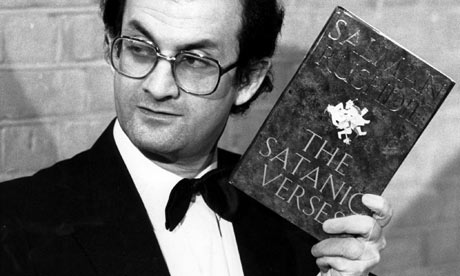
book review:Satanic Verses


This is a tour de force, a show of strength, a performance. It's the sort of novel that requires a Big Style and a lot of learning to write. It's not the sort of thing that can be attempted by just anybody. I could not write this book. Few people besides Rushdie could even attempt it. It is stamped with the mark of the man himself--his culture, his milieu, his education, his beliefs, his passion and his experience. And what are "The Satanic Verses"? They are lyrical yearnings made verbal depicting the clash between the world of rationality and that of superstition, between the world at the time of the Prophet and today's world, between the cold fog of England and the hot sweat of India and the Middle East, between the rationality of the Enlightenment and the mythology of a time long ago, between a secular interpretation of life and a religious one. In short there really is a clash of civilizations that is being worked out in today's world, and Rushdie is here to give us his take on this earth-shaking process.

Better to risk the time on Tolstoy, Melville or Joyce where one has the report of literary history as a guide. Here we have a novel reviled and revered but only a little over 22 years of age. A lot of flash and glimmer goes by the way of the popular mind toward something Great, but in time may be more clearly seen as pedestrian, even banal, faddish and brought before our eyes by the celebrity of some event--like a sentence of murder upon its author--only to fade with the yellowing of the newspapers of yesteryear.

It will stay in print for decades and remain a torn in the side of the followers of the Prophet until they lose their hatreds, their prejudices and especially their fears. Yes, Islam fears. It fears science, education, Western culture, women and much of what constitutes the post-modern world. Unlike learned arguments and reasoned debates or shouting matches that change no minds, this novel will persuade many (mostly young) minds that a religion born in the barren, superstitious desert, sired by the tribal mentality of the Bronze Age, and forced upon others by the sword has no more relevance to today's problems and challenges than the religions it replaced. The problem for the reader is not the length of the novel. It is in the fact that few readers will have the background necessary to appreciate much of the references, allusions, puns, jokes, asides, and other bits of wordsmithing from the very cosmopolitan and worldly Salman Rushdie. But no matter. It will require some effort of attention and concentration, some very real investment of time and effort on the part of the reader; but as the pages turn and the fantasy begins to stand out from the realism, as the time of Mahound clashes clearly with the time of an Indian/Muslim Bollywood actor, as the Ayesha of ancient is differentiated from the Ayesha of today, as the Gibreel of the film is made distinct from the Gibreel of legend--indeed as the web of mystery and magic, of fact and fantasy, of goats and gods becomes a fabric like a woven rug of artistry, one begins to appreciate Rushdie's intent and artistry. And this is the way it is with all great works of literature: there are levels. On the level of the mass mind, there is a world of people and events; on the level of the initiated, there is added a rich vocabulary of shared intellectual experiences. But Rushdie is no dry intellectual novelist: he can create intriguing characters and the tension necessary to sustain a narrative. Now what is needed (I believe) for all but the most learned readers is a guide to the novel written by someone who knows Hinduism, Christianity, Islam, modern culture and has a good grasp of their histories. Such a guide will be written by some academic somewhere--and indeed may have already been written, or is being written. And so I read the novel from beginning to end and found it uneven and marvelous, a bit obtuse at first but as my familiarity with Rushdie's intent, style, and structure grew, so too did my enjoyment of this rich satire. Yes, this is a satire similar in intent to the works of Voltaire or Twain however distant in style they may be. It is a satire upon not only Islam and Hinduism and the mass culture from Dhaka to Manchester, but a satire on the never-ending delusions of a pitiful, but ever hopeful humanity.