Sunday, October 31, 2010

lolita: a murder of morals or is it?


It took me a lot of time to convince myself that Lolita was not a love story but a tale of self-deception and rationalization masquerading as "love". Its a conundrum,an illusion that requires a lot of insight into Humbert Humbert and still one might be on the edge.The character's construction is a marvel in itself,you will repel and sympathise at the same time while forgetting his lecherous desires.The narrator, Humbert Humbert, is a fascinating construction. As readers, we find ourselves simultaneously repelled by his actions and sympathetic to his yearning. We are utterly charmed by his wit, intelligence and verbal acrobatics, sometimes to the point where we lost sight of what he's doing to his object of desire, Lolita.
I would suggest that all readers reaquaint themselves with the concept of the "unreliable narrator" before they sink into Humbert's hypnotic web of logic. When you find yourself sympathizing with Hum about Lolita's "cruelties", try to remember that you are seeing everything through his twisted and self-serving lens. Humbert has rationalized his behavior so deeply and reports it to us so entertainingly, that we find ourselves accepting his interpretations of people and events at face value. However, we must remember that Hum is capable of the most monsterous of deceptions (note how long it takes him to inform Lolita of her mother's demise), and of self deceptions. Read between the lines. Question his reading of events. Pay attention when his reporting is at odds with his interpretations of them. As one example, Humbert tells us that he was seduced by Lolita, giving us the impression that she was sexually mature and a willing partner. Contrast that with his throwaway mentioning of her "performing" for him in exchange for treats, and watching television as he took his pleasure in her. And don't ignore Lolita sobbing each night, as he seems to do.
Look beyond the circus to the grime beneath it, and appreciate the mastery that gives us both.


I would therefore like to restrict my comments to the morality of the book, and to those who to this day view the book with outrage. Even those who admire the book somehow feel compelled to comment that they are "disturbed" by it. Why is this? Let us first examine the novel itself.
As everybody knows, it is the story of Humbert Humbert, a full-grown, adult male--not an old man--who seduces a compliant twelve-year old girl, and then goes on to have a year or so long "affair" with her. I put the term "affair" in quotation marks, because it probably isn't appropriate to describe a sexual relationship between a full grown male and a female child in such terms. Is it safe to say that most rational human beings disapprove of such relationships? It is certainly safe to say that Nabakov--and his narrator--know that such relationships are wrong. This is important. The tale is not only told in the context of a moral universe, it is also told by a character who is in acceptance of a moral universe. Oh, he makes a comment here and there about some medieval king marrying his twelve year old cousin, but clearly, his heart isn't in it. He knows that he is a monster, a "brute."
Indeed, his goal was never to have sex with a conscious Lolita to begin with. His goal initially was only to fondle her after drugging her to induce sleep; she was never to know what he was doing. Of course this is also reprehensible, but clearly it shows a conscience at work. A conscience motivated in part by fear, to be sure, but also a conscience for the welfare--at least early on--of this little girl. Conscience is not normally a factor in purely prurient forms of entertainment.
Following this encounter, he takes Lolita on a journey across, around, and through the United States, living in hotel rooms, and buying clothes and food on the move. Toward the end of this, we find one of the most moving paragraphs in literature: "And so we rolled East . . . We had been everywhere. We had really seen nothing. And I catch myself thinking today that our long journey had only defiled with a sinuous trail of slime the lovely, trustful, dreamy, enormous country that by then, in retrospect, was no more to us than a collection of dog-eared maps, ruined tour-books, old tires, and her sobs in the night--every night, every night--the moment I feigned sleep." The narrator's revelation of such anguish on the part of his victim clearly works against the argument that this novel was merely intended to be pornographic.
Humbert makes it clear that he loves his Lolita. There can be no mistake about this. He loves the way she moves. He loves the down on her arm. He loves her grace on the tennis court. He loves the way she flicks her head at him when looking up from a book. He loves her toes, her shoes, her name. He describes her in beautiful, poignant, poetic language, memorable and moving in every respect. Indeed the English language has rarely been used so wonderfully. But nowhere in this book does he describe in such terms or any other terms her sexual characteristics, or comment at length or in glaring detail his physical relations with her.
Finally, there is no effort to sugar-coat the effect of all of this on Lolita herself. We learn that after she left Humbert, she entered into a series of tawdry sexual escapades--still at too young an age--with a debased playwright. We last see her in her late teens, married to a bumpkin, and living in a clapboard shack surrounded by weeds.
Obviously, to anybody who has bothered to read this book, the presentation of the subject matter is not what is objectionable. Therefore, what apparently disturbs most people is the subject matter itself. But why? Why doesn't the latest grisly serial-killer-of-the-month novel inspire such protest? (Has there ever been a time in the history of the world in which so many novels have been written about serial killers?) Why not the barely-disguised soft-porn trash by Danielle Steele or Jackie Collins? Or the latest Anne Rice gore fest? While Lolita is not really a morality tale, it certainly doesn't glorify its subject matter the way novels such as these do.
So what is it? I think that with Lolita Nabakov has perhaps unconsciously touched a nerve. We, as humans, are rational creatures. We know what is right, and we have set rules for ourselves to follow. Everybody agrees that murder is wrong. But sexual mores have changed and continue to change in our affluent Western societies. Abortion has become legal, which gives women more sexual freedom. Homosexuality has become acceptable, which allows men more sexual freedom. Prostitution and pornography are rampant. Without discussing the morality of any of this, our society is now in rapidly changing and uncharted territory. Perhaps the objection to Lolita is from those who look at the book, and wonder how far we are going to go.

Sunday, October 17, 2010

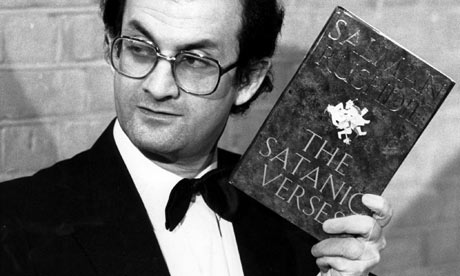
book review:Satanic Verses


This is a tour de force, a show of strength, a performance. It's the sort of novel that requires a Big Style and a lot of learning to write. It's not the sort of thing that can be attempted by just anybody. I could not write this book. Few people besides Rushdie could even attempt it. It is stamped with the mark of the man himself--his culture, his milieu, his education, his beliefs, his passion and his experience. And what are "The Satanic Verses"? They are lyrical yearnings made verbal depicting the clash between the world of rationality and that of superstition, between the world at the time of the Prophet and today's world, between the cold fog of England and the hot sweat of India and the Middle East, between the rationality of the Enlightenment and the mythology of a time long ago, between a secular interpretation of life and a religious one. In short there really is a clash of civilizations that is being worked out in today's world, and Rushdie is here to give us his take on this earth-shaking process.

Better to risk the time on Tolstoy, Melville or Joyce where one has the report of literary history as a guide. Here we have a novel reviled and revered but only a little over 22 years of age. A lot of flash and glimmer goes by the way of the popular mind toward something Great, but in time may be more clearly seen as pedestrian, even banal, faddish and brought before our eyes by the celebrity of some event--like a sentence of murder upon its author--only to fade with the yellowing of the newspapers of yesteryear.

It will stay in print for decades and remain a torn in the side of the followers of the Prophet until they lose their hatreds, their prejudices and especially their fears. Yes, Islam fears. It fears science, education, Western culture, women and much of what constitutes the post-modern world. Unlike learned arguments and reasoned debates or shouting matches that change no minds, this novel will persuade many (mostly young) minds that a religion born in the barren, superstitious desert, sired by the tribal mentality of the Bronze Age, and forced upon others by the sword has no more relevance to today's problems and challenges than the religions it replaced. The problem for the reader is not the length of the novel. It is in the fact that few readers will have the background necessary to appreciate much of the references, allusions, puns, jokes, asides, and other bits of wordsmithing from the very cosmopolitan and worldly Salman Rushdie. But no matter. It will require some effort of attention and concentration, some very real investment of time and effort on the part of the reader; but as the pages turn and the fantasy begins to stand out from the realism, as the time of Mahound clashes clearly with the time of an Indian/Muslim Bollywood actor, as the Ayesha of ancient is differentiated from the Ayesha of today, as the Gibreel of the film is made distinct from the Gibreel of legend--indeed as the web of mystery and magic, of fact and fantasy, of goats and gods becomes a fabric like a woven rug of artistry, one begins to appreciate Rushdie's intent and artistry. And this is the way it is with all great works of literature: there are levels. On the level of the mass mind, there is a world of people and events; on the level of the initiated, there is added a rich vocabulary of shared intellectual experiences. But Rushdie is no dry intellectual novelist: he can create intriguing characters and the tension necessary to sustain a narrative. Now what is needed (I believe) for all but the most learned readers is a guide to the novel written by someone who knows Hinduism, Christianity, Islam, modern culture and has a good grasp of their histories. Such a guide will be written by some academic somewhere--and indeed may have already been written, or is being written. And so I read the novel from beginning to end and found it uneven and marvelous, a bit obtuse at first but as my familiarity with Rushdie's intent, style, and structure grew, so too did my enjoyment of this rich satire. Yes, this is a satire similar in intent to the works of Voltaire or Twain however distant in style they may be. It is a satire upon not only Islam and Hinduism and the mass culture from Dhaka to Manchester, but a satire on the never-ending delusions of a pitiful, but ever hopeful humanity.

Thursday, September 30, 2010

the land of misinterpreted faith...

The dispute over Ramjanmabhoomi-Babri Masjid, it is said, is creation of the colonial rule. It is difficult to be very sure on how far direct is the hand of the colonial rule in inventing and or sustaining the dispute between some elements from both the communities. However, there is little doubt that the colonial rule benefited from the dispute and therefore did not seem to take effective steps to see the dispute resolved. The authorities under the Colonial rule allowed the dispute over title of the land to acquire communal overtones. Whatever the former colonial masters did, or omitted to do, the post-Colonial state fared even worst in the matter. Post-Colonial State allowed the dispute over the land title to almost completely polarise the two communities. Essentially a title suit between the plaintiffs and the defendants over a piece of land was allowed to acquire religious and communal colour with competing all India mobilisations by political leadership belonging to both the communities. Even the most secular Prime Minister of the country - Jawaharlal Nehru found himself unable to resolve the dispute and / or stop it from acquiring communal colour, when he had the opportunity in 1949.

There are no two opinions that in the year 1528 a mosque was built by Mir Baqi by one of the Governors of the Mughal Emperor Babar. The Sangh Parivar maintains that this mosque was built after destroying a Ramjanmabhoomi temple, which existed on the land whereas the Muslim political leaders as well as most reputed historians of integrity insist that there is no credible proof that there was any Ramjanmabhoomi temple.


After the anti-British rebellion in 1857, the crown proclaimed that it would remain aloof and would not interfere in the religious matters of people of the Country. The Colonial power however, was often called upon to mediate disputes between communities. The Colonial State did not prove to be an honest mediator in the disputes. The state had its own axe to grind - legitimising the rule of the intruder being the uppermost. At times, the state even invented and created new disputes so that it was called upon the mediate. Ramjanmabhoomi-Babri Masjid dispute appears to one of such disputes created by the Colonial rulers. The District Gazetteer of 1905 notes that till 1855, Hindus and Muslims prayed in the same premises which is now contentious Ramjanmabhoomi-Babri Masjid site. After 1857 rebellion, an outer enclosure was put in front of the mosque and the Hindus who were forbidden access to the inner yard raised an outer platform (chabutra).


Hindu priests wanted a temple constructed on the Chabutra to be able to conduct their worship without vagaries of weather, as Chabutra was an open platform. It is not clearly known as to when and how the Chabutra came to be constructed, and whether the Chabutra was raised on a land having legal title or an usurped land adjoining the mosque called Babri Mosque.


In 1934 riots, which were triggered off by the slaughter of a cow in the village of Shahjahanpur near Ayodhya, riotous mobs demolished part of the wall surrounding the mosque and damaged the domes. However, the mosque was restored at the cost of the Government.Interestingly, there was also litigation between Shia Central Board of Waqf and Sunni Central Board of Waqf in the Court of Civil Judge, Faizabad. An inquiry was conducted the Commissioner of waqfs under the UP Muslim Wafqs Act. By judgement dated 23/3/46, it was held that the mosque was found by Babar Shah and used by members of both sects.


Till 22nd December1949, Muslims offered namaz in the Babri Masjid. However, on the night of 22nd December 1949, idols of Bhagwan shri Ramchandra were surreptitiously smuggled and installed inside the mosque. Constable Mata Prasad at Ayodhya Police Station reported the incident next day morning and the District Magistrate K.K. Nayar sent the following message to the Chief Minister and Chief Secretary by radiogram:
"A few Hindus entered Babri Masjid at night when the masjid was deserted and installed a deity there, DM and SP and force at spot. Situation under control, Police picket of 15 persons was on duty at night but did not apparently act."
K. K. Nayar, who later contested elections on the then Jan Sangh ticket, wrote in his diary:
"The crowd made a most determined attempt to force entry. The lock was broken and policemen rushed off their legs. All of us, officers and men, somehow pushed the crowd back and held the gate. The gate was secured and locked with a powerful lock brought from outside and the police force was strengthened."


The decade of 1980 will be remembered as a bloody decade with communal clashes all over the country as the issue of Ramjanambhumi was politicised and nationalised by the Sangh Parivar. The Ramjanambhumi, which had hitherto remained a dispute between some elements from both communities in Ayodhya, was taken to every nook and corner in most cities and even rural areas all over the country. The demand for which the mobilisation was aimed was to open the lock of the Babri Masjid and permit puja and darshan. After the lock was opened, the next demand was handing over the entire site for construction of Ramjanmabhumi Temple and shifting of the mosque outside panchkoshi parikrama. Legally, it was difficult to achieve this fete without the intervention of the courts and the state. The issue of title of the property, which is the main legal issue involved in the dispute pending in the courts operates against the protagonist of Ramjanmabhumi temple. For right to worship cannot be claimed as an easement on somebody else's property. So far as law is concerned, faith and belief, or even proof of place of birth of Bhagwan Ramchandra is also not a relevant issue to decide the title and / or grant right to worship. Agitational mobilisation by the Sangh Parivar was to pressurise the state and the courts to act and the pressure did work.
First the UP State acquired the place surrounding the place in the name of providing certain facilities to the pilgrims, the site on which Rajiv Gandhi laid foundation stone of the Ramjanmabhumi on in November 1990. Babri Masjid was then demolished on 6.12.92 by mobs mobilised by the Sangh Parivar. The Courts as well as the state allowed the mob to assemble in the naïve belief that the Mosque will not be touched.


Then the Union Government issued ordinance named 'Acquisition of Certain Area at Ayodhya Ordinance' on 7.1.93 for acquisition of 67.703 acres of land, including the site of Babri Masjid. The Ordinance was later replaced by an Act. The Union Government also made a Special Reference under Article 143(1) of the Constitution of India to the Supreme Court for the opinion of the Court on:
"Whether a Hindu temple or any Hindu religious structure existed prior to the construction of the Ram Janma Bhumi - Babri Masjid (including the premises of the inner and outer courtyards of such structure) in the area on which the structure stood".
The reference itself was slanted in favour of the majority community. The Court was called upon to give its opinion whether any Hindu religious structure existed prior to construction of Ram Janma Bhumi - Babri Masjid. ... The structure that stood was certainly not "Ramjanma Bhumi" but Babri Masjid admittedly constructed by Mir Baqi. The only contention of the protagonist of Ramjanma Bhumi Temple being that the same was after demolition of Janam Asthan Temple. Secondly, no time frame was prescribed for examination of existence of Ram Janma Bhumi - Babri Masjid. If the referendum had been answered in positive, the Union Government would have been compelled to hand over the entire site on which Babri Masjid stood to the Hindu litigants or a trust or association. The Supreme Court however rejected the reference as superfluous.


To summarise, admittedly, Babri Masjid was built by Mir Baqi in the year 1528 and is noted in the waqf register of Sunni Central Board of Waqf. In 1885 and 1886, the claim of the Hindu litigants was only on the Chabutra as they wanted to construct a structure to protect the devotees from the vagaries of the weather and no more. On the strength of adverse possession, the courts dealing with the dispute during the colonial period rejected the prayers of the Hindu litigants to construct any structure even on the Chabutra. The prayers were rejected even though the courts held (it is not known on what evidence) that the Masjid was built on land held sacred by the Hindus but that occurred 356 years ago on the same spot. After independence, the Hindu litigants adopted incremental approach, slowly enlarging their rights and claims with combination of surreptitious acts, agitational mobilisation and repeated applications to the court. Surreptitious acts when no legal claim left on their side. Another round of litigation on threat of agitational mobilisation. The claims were based not on the strength of title to the property but on their right to unhindered and unrestricted worship. After the idols were smuggled inside the Mosque, there was another round of litigation, which virtually ignored the title and turned the court into a receiver of the property giving the Hindus increasing access to the property as and by way of right to worship, while the Muslim community was denied the access in spite of the fact that the property was a waqf property. After the locks were opened in 1986 on the ground that there would be no problem maintaining law and order if the locks are open, the Hindu nationalist forces were emboldened even more. As they were mobilising their forces and indulging into hate propaganda, the State remained a mute bystander refusing to act and take preventive measures for maintenance of law and order. Even the courts when they had the opportunity did not act decisively and the hoodlums of Hindu nationalist forces were allowed to assemble in large numbers, ultimately resulting in demolition of Babri Mosque and construction of a make shift temple. The Courts as well as the executive rewarded those who demolished the Mosque by legitimising the "rights" acquired by force in the name of maintaining status - quo and maintaining law and order. The Central Govt. acquired the disputed site and the surrounding areas under the Acquisition Act, thus depriving the Muslim litigants of their defence or claim of adverse possession to the disputed site. The Supreme Court majority Judgement legitimised the acquisition by state in the name of maintaining public order. The litigants from the minority community, we feel, are fighting a losing battle - not because their claim to the title of the disputed site is weak or defective, but because they cannot match the power of the Hindu nationalist forces in creating law and order problem, which is material in influencing the decision making in our country. The Hindu nationalist forces have enlarged their rights and claims from Chabutra to worship on the very disputed site not because of their legitimate claim but by threatening not to obey the orders of the Court in matters of "faith".


Thursday, August 5, 2010

a valley of pain,agony and despair...


On March 23, 2000 five civilians Zahoor Ahmed Dalal, Juma Khan, Mohammad Yussuf Malik, Juma Khan (different from the one mentioned earlier) and Bashir Ahmed Bhat werekilled at Pathribal and the Government claimed them to be responsible for the massacre of 35 Sikhs at Chattisinghpora on March 21, 2000.They were branded as terrorists for life...In the aftermath of the Sikh massacre at Chattisinghpora, the security forces had claimed to have eliminated five 'foreign militants' responsible for the carnage in an encounter in Pathribal forests. The bodies of the five persons killed were charred beyond recognition. Subsequent public protests forced the state administration to exhume the five bodies and order DNA tests on them to establish the true identity of those killed. However, the DNA samples collected and sent to laboratories in Kolkata and Hyderabad were found to be fudged. An embarrassed government suspended the entire team of forensic experts headed by Dr Balbir Kaur, head of department of forensic science, Medical College, Srinagar. Later, fresh samples were collected by experts from Kolkata and Hyderabad. The final reports received from the two laboratories on Monday said there was conclusive evidence that the five people killed in Pathribal were locals and not foreign militants as claimed by the police.


When I think about a certain Tufail Mattoo,the 17 year old who was killed by a tear gas canister which struck his head during a protest in srinagar in June this year,I think of these lines from Randy Travis's song "valley of pain"

"DON'T LET ME GROW BITTER I PRAY

GIVE ME STRENGTH TO CARRY ON

MY WAY IM LEANIN'

ON YOU LIKE A WOODEN CANE WHILE

I'M WALKIN THROUGH I'M WALKIN THROUGH

THE VALLEY OF PAIN"

The striking feature of all these heinous crimes committed was the brazen and barefaced realization among the murderers that they will get away with it.What protest we are witnessing in Kashmir today is not the outcome of prvocateur's self centred ambitions to oust an Abdullah but these are women with stones and pots and pans of their homes out on the street to let the Government know that the faith with which they had elected Omar is now long gone.Violence makes you impatient and impatience gives you a certain strength and it becomes a vicious cycle.


Our PM is a noble man and not much of a statesman unfortunately,not a hardliner and certainly not the best man for the Kashmir today.He talks about economic reforms and developmental works at the time when the protesters have lost all faith in Governance.Omar is right when he says that there is a need for a "political package",one that restores the faith and curbs the ebullient separatist ideas so fervent currently.People are in turmoil and suffocated with their unstable identity on the world map and it will take more than a speech by Dr. Abdullah on national televison to heal all these wounds and angst.


Once as a kid I was told that what describes us as human is the ability to constantly feel the pain of others,to understand the meaning of their tears and to pray for them rather than praying for ourselves.Torn between political mess,geographical wrangling and economic distress....kashmir is bleeding.It will need more than honest prayers of all the indians....and thats the saddest fact.

Saturday, July 31, 2010

indian shopping: a culture of chaos


Crowds, clutter, cacophony—these are the defining characteristics of shopping in India. Or to borrow a concept from Clotaire Rapaille’s book, The Culture Code: An Ingenious Way to Understand Why People Around the World Live and Buy as They Do, the Indian “culture code” for shopping in India is Chaos. In fact, taking the Indian shopper out of chaos is like taking a fish out of water. We feel at home in the hustle bustle of local markets and start having withdrawal symptoms in a structured sterile atmosphere


Delhi’s Khan Market is an upscale reinterpretation of the bazaar. It is as upscale as it gets in traditional retail—commanding India’s highest retail real estate rental, and attracting a steady stream of high-value shoppers—and yet there is nothing upscale about its physical reality. Neat, clean, structured, streamlined, refined, aesthetically pleasing or even pleasant-smelling—these are not words that you can associate with the Khan Market experience. What you have instead is a full frontal assault on the senses, the constant refrain of honking cars circling the perimeter, a jam-packed disorderly parking lot, merchandise spilling on to the sidewalks, walls lined with foreign magazines, a bangle-and-bindi-wallah’s stall juxtaposed alongside a store that sells designer sunglasses, uneven dusty back lanes where you have to watch your step. In the midst of this haphazard retail madness are charming stores and cafés tucked up tiny winding staircases—delightful, whimsical, providing that rush of discovery, each one unique in character. This is the chaotic Indian version of the quaint and trendy West Village in New York.


Now let’s switch tracks to luxury brands in India, which inhabit the other end of the spectrum, ensconced in beautiful shopping malls, high ceilings, wide corridors, stores neatly lined up with glass fronts, the merchandise pre-edited and displayed like pieces of art in a gallery. There is no chaos here, no clutter, no cacophony, and as yet, no crowds—there is instead the highly controlled, air-conditioned, squeaky-clean, serene setting of a modern luxury mall like DLF Emporio in Delhi or UB City in Bangalore or the Grand Hyatt Plaza in Mumbai. These malls are purpose-built to provide a sumptuous environment for luxury brands, but the piquant question that the Khan Market experience raises is this: If the culture code for shopping in India is “Chaos”, would luxury brands benefit from recognizing and leveraging it?


Most luxury professionals would baulk at even having “luxury” and “chaos” mentioned in the same sentence. Admittedly Khan Market is not quite luxury in the traditional sense, but if Good Earth can sell Manish Arora crockery, Ogaan has a line-up of Indian designers, and Amrapali stocks high-end jewellery, we are in the luxury ballpark, talking to the same consumer who has both the means and the inclination to buy luxury. In which case, why not bring the mountain to Mohammed? In other words, bring Western luxury brands to traditional high-end markets such as Khan Market—or South Extension or Greater Kailash or equivalent ones in other cities—embracing the vibrant chaos and the well-heeled crowds that come with it


Even in the new luxury malls springing up, I would make a case for incorporating the comforting elements of chaos. Instead of the rarefied atmosphere of a luxury cathedral, create the merry hustle bustle of a Hindu temple. Instead of awe-inspiring interiors, create warm and inviting ones. Instead of wide-open spaces, intimate ones. Instead of minimalist displays, lush ones. Instead of the cookie-cutter sameness, uniqueness and character.

Incorporate a whiff of Khan Market, allow the thrill of discovery, make room for whimsy and charm. Create luxurious chaos.


Sunday, July 18, 2010

Ayn Rand:the propagation of immorality


Herewith, a few excerpts from the Rand collection.
• “It was the morality of altruism that undercut American and is now destroying her.”
• “Capitalism and altruism are incompatible; they are philosophical opposites; they cannot co-exist in the same man or in the same society. Today, the conflict has reached its ultimate climax; the choice is clear-cut: either a new morality of rational self-interest, with its consequence of freedom…or the primordial morality of altruism with its consequences of slavery, etc.”
• Then from one of her arias for heldentenor: “I am done with the monster of ‘we,’ the word of serfdom, of plunder, of misery, falsehood and shame. And now I see the face of god, and I raise this god over the earth, this god whom men have sought since men came into being, this god who will grant them joy and peace and pride. This god, this one word: ‘I.’”
• “The first right on earth is the right of the ego. Man’s first duty is to himself.”
• “To love money is to know and love the fact that money is the creation of the best power within you, and your passkey to trade your effort for the effort of the best among men.”
• “The creed of sacrifice is a morality for the immoral….”

This odd little woman is attempting to give a moral sanction to greed and self interest, and to pull it off she must at times indulge in purest Orwellian newspeak of the “freedom is slavery” sort. What interests me most about her is not the absurdity of her “philosophy,” but the size of her audience .She has a great attraction for simple people who are puzzled by organized society, who object to paying taxes, who dislike the “welfare” state, who feel guilt at the thought of the suffering of others but who would like to harden their hearts. For them, she has an enticing prescription: altruism is the root of all evil, self-interest is the only good, and if you’re dumb or incompetent that’s your lookout.

She is fighting two battles: the first, against the idea of the State being anything more than a police force and a judiciary to restrain people from stealing each other’s money openly. She is in legitimate company here. There is a reactionary position which has many valid attractions, among them lean, sinewy, regular-guy Barry Goldwater. But it is Miss Rand’s second battle that is the moral one. She has declared war not only on Marx but on Christ. Now, although my own enthusiasm for the various systems evolved in the names of those two figures is limited, I doubt if even the most anti-Christian free-thinker would want to deny the ethical value of Christ in the Gospels. To reject that Christ is to embark on dangerous waters indeed. For to justify and extol human greed and egotism is to my mind not only immoral, but evil. For one thing, it is gratuitous to advise any human being to look out for himself. You can be sure that he will. It is far more difficult to persuade him to help his neighbor to build a dam or to defend a town or to give food he has accumulated to the victims of a famine. But since we must live together, dependent upon one another for many things and services, altruism is necessary to survival. To get people to do needed things is the perennial hard task of government, not to mention of religion and philosophy. That it is right to help someone less fortunate is an idea which ahs figured in most systems of conduct since the beginning of the race. We often fail. That predatory demon “I” is difficult to contain but until now we have all agreed that to help others is a right action. Now the dictionary definition of “moral” is: “concerned with the distinction between right and wrong” as in “moral law, the requirements to which right action must conform.” Though Miss Rand’s grasp of logic is uncertain, she does realize that to make even a modicum of sense she must change all the terms. Both Marx and Christ agree that in this life a right action is consideration for the welfare of others. In the one case, through a state which was to wither away, in the other through the private exercise of the moral sense. Miss Rand now tells us that what we have thought was right is really wrong. The lesson should have read: One for one and none for all.


It is revealing that as Rand refined her idea of the heroic personality from the Howard Roark of The Fountainhead to John Galt in Atlas Shrugged, the type became steadily drained of, indeed, personality. Galt seems little better than a robotic mouthpiece of merciless ideology. Howard Roark was already peculiar enough, since he would just sit staring at the phone while waiting for work. He might at least have read magazines. Subsidiary characters, like Hank Rearden and Dagny Taggart, possess something more like real personalities. This deadness of such central characters is an excellent warning that Rand had passed beyond a desire for mere human beings as her ideals. (Jung probably would have detected an animus projection.) This was an unhelpful bit of falseness, not to mention humorlessness, with which to burden her case for capitalism.

Ayn Rand’s “philosophy” is nearly perfect in its immorality, which makes the size of her audience all the more ominous and symptomatic as we enter a curious new phase in our society. Moral values are in flux. The muddy depths are being stirred by new monsters and witches from the deep. Trolls walk the American night. Caesars are stirring in the Forum. There are storm warnings ahead. But to counter trolls and Caesars, we have such men as Lewis Mumford whose new book, The City in History, inspires. He traces the growth of communities from Neolithic to present times. He is wise. He is moral: that is, he favors right action and he believes it possible for us to make things better for us (not “me”!). He belongs to the currently unfashionable line of makers who believe that if something is wrong it can be made right, whether a faulty water main or a faulty idea. May he flourish!

On Tagore's anniversary....


From renovating Tagore auditoria, establishing new ones in major cities, publishing a book on his paintings to running a special train to Dhaka, the government has drawn up several plans to perpetuate the legacy of Nobel Laureate Rabindranath Tagore to mark his 150Th birth anniversary.


Tagore,the first Nobel laureate Of India and a phenomena in his own has been a pandemic idea throughout eastern India and Bangladesh but the western world mainly Europe has now forgotten this charisma it once reverberated with.They simply don't read him anymore nor do the India progeny of the west who are more enlivened by levis and twilight than Gitanjali. The west has long ago declared Tagore as the 'bright pebbly eyes of the Theosophists' and has disgraced his contemporary thinking by referring it as a descent of Hinduism and a flow from Ganges.That's what the West does the best....Europe has Americanised and America has probably Mars-ianised.Yes,I shall keep a patriotic tone on his 150Th anniversary.


If Tagore had been a religious thinker and that too a Hindu by vision then it baffles me how Bangladesh which is mainly a Muslim state adopt his song "amar sonar bangla" as its national anthem.London has honoured and rejected Tagore but Indians need to realise the embodiment of mosaic of thoughts,colours and ideas Tagore represents.


It is indispensable to talk of Tagore and not of his distinction with Gandhi,the two foremost thinkers of all time.Nehru said on the death of Tagore "It is not so much because of any single virtue but because of the tout ensemble,that i felt that among the world's great men today Gandhi and Tagore were supreme human beings.What good fortune for me to have come in close contact with them"Tagore and Gandhi were both admirers of each other but differed in the way of thinking about issues like nationalism,internationalism,patriotism with Tagore's view being more of a logic based and less of a conventional nationalist-but India need Gandhi's emotional chauvinism with the nation more than the Tagore's pragmatism and unparochial outlook which is what India has post 1991.Tagore's political thought was complex. He opposed imperialism and supported Indian nationalists. His views have their first poetic release in Manast, mostly composed in his twenties.Evidence produced during the Hindu-German conspiracy trial and later accounts affirm his awareness of the Ghadarite conspiracy, and stated that he sought the support of Japanese Prime Minister and former Premier . Yet he lampooned the Swadeshi movement, denouncing it in "The Cult of the Charka", an acrid 1925 essay. He emphasized self-help and intellectual uplift of the masses as an alternative, stating that British imperialism was a "political symptom of our social disease", urging Indians to accept that "there can be no question of blind revolution, but of steady and purposeful education".Such views enraged many. He narrowly escaped assassination by Indian expatriates during his stay in a San Francisco hotel in late 1916. The plot failed only because the would-be assassins fell into argument. Yet Tagore wrote songs lionizing the Indian independence movement and renounced his knighthood in protest against the 1919 Jallianwala bagh massacre. Two of Tagore's more politically charged compositions, "chitto jettha bhayashunyo" ("Where the Mind is Without Fear") and "ekla chalo re" ("If They Answer Not to Thy Call, Walk Alone"), gained mass appeal, with the latter favoured by Gandhi. Despite his tumultuous relations with Gandhi, Tagore was key in resolving a Gandhi-Ambedkar dispute involving separate electorates for untouchables, ending Gandhi's fast "unto death".


Tagore lampooned rote schooling: in "The Parrot's Training", a bird is caged and force-fed pages torn from books until it dies.These views led Tagore, while visiting Santa Barbara on 11 October 1917, to conceive of a new type of university, desiring to "make Santiniketan the connecting thread between India and the world [and] a world center for the study of humanity somewhere beyond the limits of nation and geography."Here, Tagore implemented a brahmacharya pedagogical structure employing gurus to provide individualised guidance for pupils. Tagore worked hard to fund raise for and staff the school, even contributing all of his Nobel Prize money. Tagore’s duties as steward and mentor at Santiniketan kept him busy; he taught classes in mornings and wrote the students' textbooks in afternoons and evenings.Tagore also fundraised extensively for the school in Europe and the U.S. between 1919 and 1921


Tagore was not only a creative genius, he was a great man and friend to many. For instance, he was also a good friend from childhood to the great Indian Physicist, Bose.Tagore had a good grasp of modern - post-Newtonian - physics, and was well able to hold his own in a debate with Einstein in 1930 on the newly emerging principles of quantum mechanics and chaos. His meetings and tape recorded conversations with his contemporaries such Albert Einstein stand as cultural landmarks, and show the brilliance of this great man.


Rabindranath lived in one of the southern rooms on the ground floor of Udayan. After his illness he had become susceptible to heat, so an air conditioner had been installed in his bedroom. The room was not large. On one side a long table stood against the wall with its rows of medicine bottles, tonics, glasses. There was a bed, an armchair, some books in a small bookcase, and a few leather-stuffed cane stools for visitors. On the walls hung a couple of his own pictures, the picture of a horse by the Chinese artist Ju Peon, and a Japanese cloud-filled landscape. Beside it, there was another smaller room. The whole world: all the world's mountains vistas oceans and cities, all life's togetherness and loneliness, today, for the poet was confined within these two rooms and the two verandas on the sides.


Where the mind is without fear and the head is held high;
Where knowledge is free;
Where the world has not been broken up
into fragments by narrow domestic walls;
Where words come out from the depth of truth;
Where tireless striving stretches its arms towards perfection;
Where the clear stream of reason
has not lost its way into the dreary desert sand of dead habit;
Where the mind is led forward by thee into ever-widening thought and action---
Into that heaven of freedom, my Father, let my country awake.
Excerpt from Gitanjali.....